
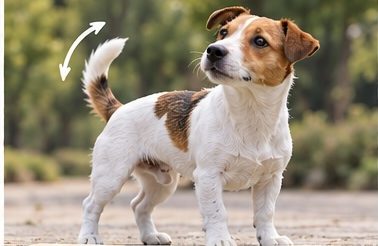
When you see a dog running toward you with its tail wagging, what's your first reaction?
"It must be so happy!"
But did you know? When a dog wags its tail, it doesn't necessarily mean it's happy.
Excitement, nervousness, alertness, and even anger can all cause a dog to wag its tail.
For dogs, who cannot speak, their tails are like a special language. The amplitude, speed, and direction of the wagging, as well as the position of the tail, can all reveal their current emotions.
Today, let’s learn to understand a dog’s “tail language” together!
🐾 01|Swinging widely and quickly: I'm so happy!
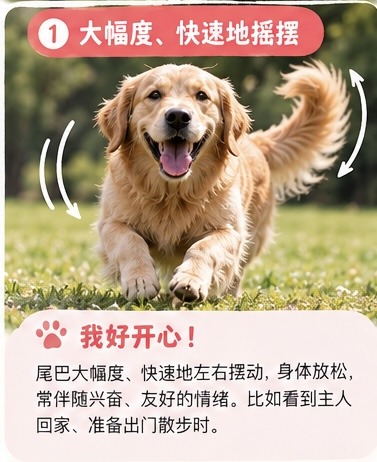
When dogs see their familiar owner come home or get ready to go for a walk, they often wag their tails excitedly.
Their tails usually swing from side to side in wide arcs, and their bodies appear very relaxed. Some dogs even get so happy that their whole rear ends start wiggling along!
This type of tail wagging usually indicates excitement, friendliness, and positive emotions.
However, it’s important to note that wagging its tail rapidly doesn’t necessarily mean the dog is happy. We also need to observe whether its body is relaxed, whether its facial expression is gentle, and whether it approaches us on its own.
🐾 02|Swaying gently and slowly: I'm still watching...
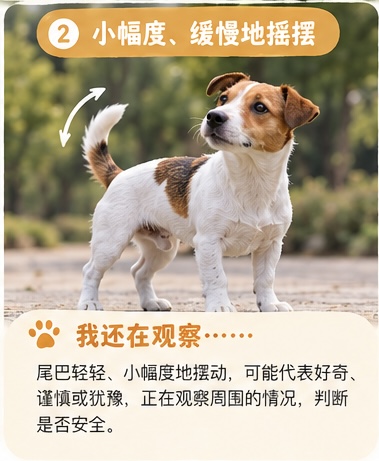
When dogs encounter strangers, other animals, or unfamiliar environments, they may wag their tails gently and in small movements.
At this moment, they may be observing their surroundings, trying to determine whether what they see is safe.
This kind of tail wagging doesn't necessarily mean fear; it could also indicate curiosity, hesitation, or caution.
“Who are you? Can I trust you?”
If your dog’s body seems stiff, its ears are pinned back, or it keeps licking its lips, you should pay extra attention to see if it’s feeling anxious.
At this point, it’s best to give it some space so it can explore its surroundings at its own pace, rather than rushing to reach out and pet it.
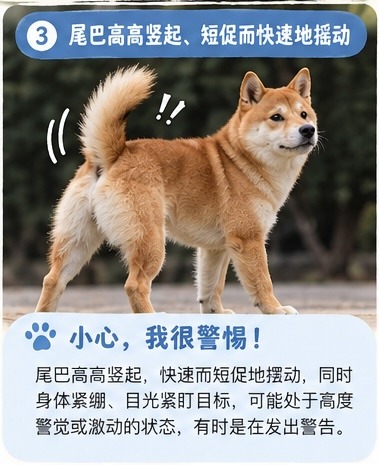
🐾 03|Tail held high and wagging short, quick strokes: Watch out—I’m on my guard.
You might think that the faster a dog wags its tail, the happier it is.
But that's not the case!
When a dog’s tail is held high and wags rapidly in short bursts, while its body is tense and its gaze is fixed on a specific target, it may be in a state of high alert or excitement.
Some dogs may even be trying to warn you.
Wagging a tail doesn't mean the dog is friendly, and it certainly doesn't mean it's okay to touch it.
If you encounter a dog like this, never approach it rashly just because it’s wagging its tail.
🐾 04|Tail hanging low, wagging gently: I'm a little anxious...

Sometimes, dogs will hold their tails very low and wag them gently from side to side.
This may mean that it is feeling nervous, uncertain, or trying to defuse the current interaction.
If the tail is tucked even further between the legs, it usually means the dog is experiencing more pronounced fear or stress.
Imagine a timid dog arriving in an unfamiliar environment for the first time—it might keep its head down, tuck its tail between its legs, and cautiously survey its surroundings.
At this moment, what it needs is not a forced hug, but patience, understanding, and a safe space where it can feel secure.
🔍 To understand the tail, you must also understand the whole body
A dog's tail is not a device that directly displays its emotions.
The same tail-wagging gesture can have completely different meanings in different contexts.
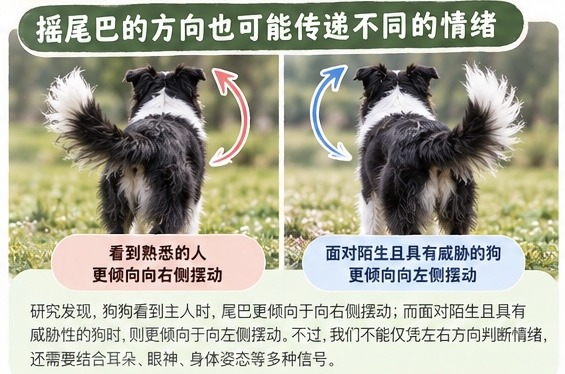
Scientific research has also found that the direction in which a dog wags its tail may be related to its emotional state.
A study published in *Current Biology* found that when dogs see their owners, their tails tend to wag more toward the right side of their bodies; when faced with unfamiliar and threatening dogs, however, their tails tend to wag more toward the left.
However, this doesn't mean we can accurately gauge a dog's mood based solely on whether it's swaying from side to side.
To truly understand them, you also need to consider the position of the ears, the look in its eyes, body posture, muscle tension, and the surrounding environment.
Every dog has its own way of communicating.
Learning to observe—rather than rushing to conclusions—is the first step toward understanding them.
💔 What if a dog loses its tail?
At this point, you may have noticed that:
It turns out that such a tiny tail actually carries so much information.
However, not all dogs have the opportunity to retain this important “tool for expressing emotions.”
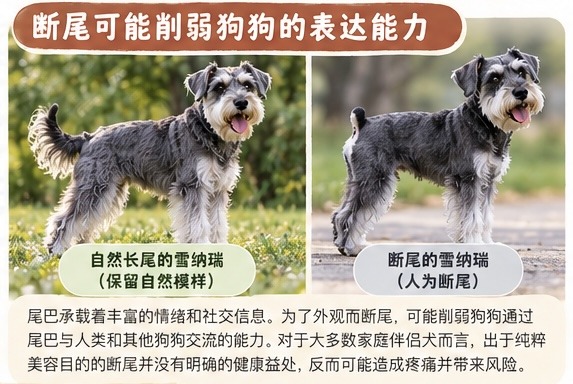
To meet the traditional appearance standards for certain dog breeds, some puppies undergo tail docking shortly after birth.
For example, there has long been a tradition of docking the tails of some Schnauzers, Dobermans, Rottweilers, and Poodles.
But tail docking does more than just change their appearance.
It may also impair a dog's ability to communicate with the outside world through its tail.
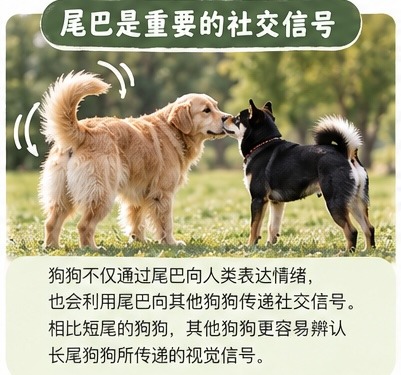
Dogs not only use their tails to express emotions to humans, but also to send social signals to other dogs.
A study published in *Behaviour* found that, compared to dogs with short tails, other dogs are better able to recognize the visual signals conveyed by dogs with long tails.
This means that tail length may affect communication between dogs.
Of course, having their tails docked doesn’t mean dogs can no longer express their emotions. They can still communicate with us through their ears, eyes, facial expressions, vocalizations, and body language.
However, when their tails are artificially shortened, they may lose some of the ways they originally had to express themselves.
It’s like a book with a few pages torn out—the story can still continue, but it’s missing some details that could have been understood.
🌱 Beauty should not require a dog to lose its tail
Some people believe that dogs with docked tails look more lively and well-groomed, and better match the familiar image of their breed.
But have we ever stopped to think:
Is this kind of “beauty” something dogs actually need, or is it a standard imposed on them by humans?
For most family companion dogs, tail docking performed solely for cosmetic reasons offers no clear health benefits.
On the contrary, tail docking can cause pain and carry a risk of bleeding, infection, and other complications.
Several veterinary professional organizations, including the American Veterinary Medical Association (AVMA), oppose tail docking in dogs performed solely for cosmetic purposes.
Of course, if a tail requires surgery due to severe trauma, a tumor, or another medical condition, that is a different matter. Necessary medical treatment for health reasons is fundamentally different from tail docking performed solely for cosmetic reasons.
We respect every dog that has had its tail docked, and we shouldn't blame their owners for it.
But when it comes to puppies that haven't been born yet, we can make different choices.
Appreciate tails that hang naturally, tails that sway from side to side when excited, and tails that are curly, fluffy, slender, or even tails that "do not match a breed standard."
Because they don't need to conform to any artificially defined standard in the first place.
A dog's tail isn't just a part of its body—it's also a way for dogs to communicate with the world.
The next time you see a dog wagging its tail, take a moment to observe what it’s really trying to tell you.
I also hope that in the future, more puppies will be able to run and wag their tails freely—with their natural tails intact—and fully express every emotion.
Let the dogs keep their tails—and let them express themselves in their own way. 🐾
Author

lisaxia@vetlog.net
Related Articles
Why are terriers so stubborn, while Golden Retrievers are like "angels"?
Have you ever been in this situation: A friend’s Golden Retriever—the moment you sit down, it’s already resting its head on your...
Read all